Trail Racing Tips for Road Runners
*Originally published on Salty Running
After a summer and fall of trail running, the road 5K I was scheduled to race last weekend didn’t seem quite right. Looking for a break for my body and mind, I found a small trail race in a neighboring town with a 5.3-mile option. Perfect!
During the race, however, there were many times I thought to myself: “Huh, this is really a totally different ball game than racing on the roads! I wish I had known….” Those short 5.3 miles taught me a lot, but how much better could I have done if I’d been forewarned of a few key things? Maybe I could have even out-kicked that young runner in front of me at the end; who knows?
I resolved to do my research for next time, and to share my findings with you. I polled my Salty sisters for their best trail-racing tips, and combined these with what I learned. So here you have it: our Salty Collection of Trail Racing Tips for Road Runners.
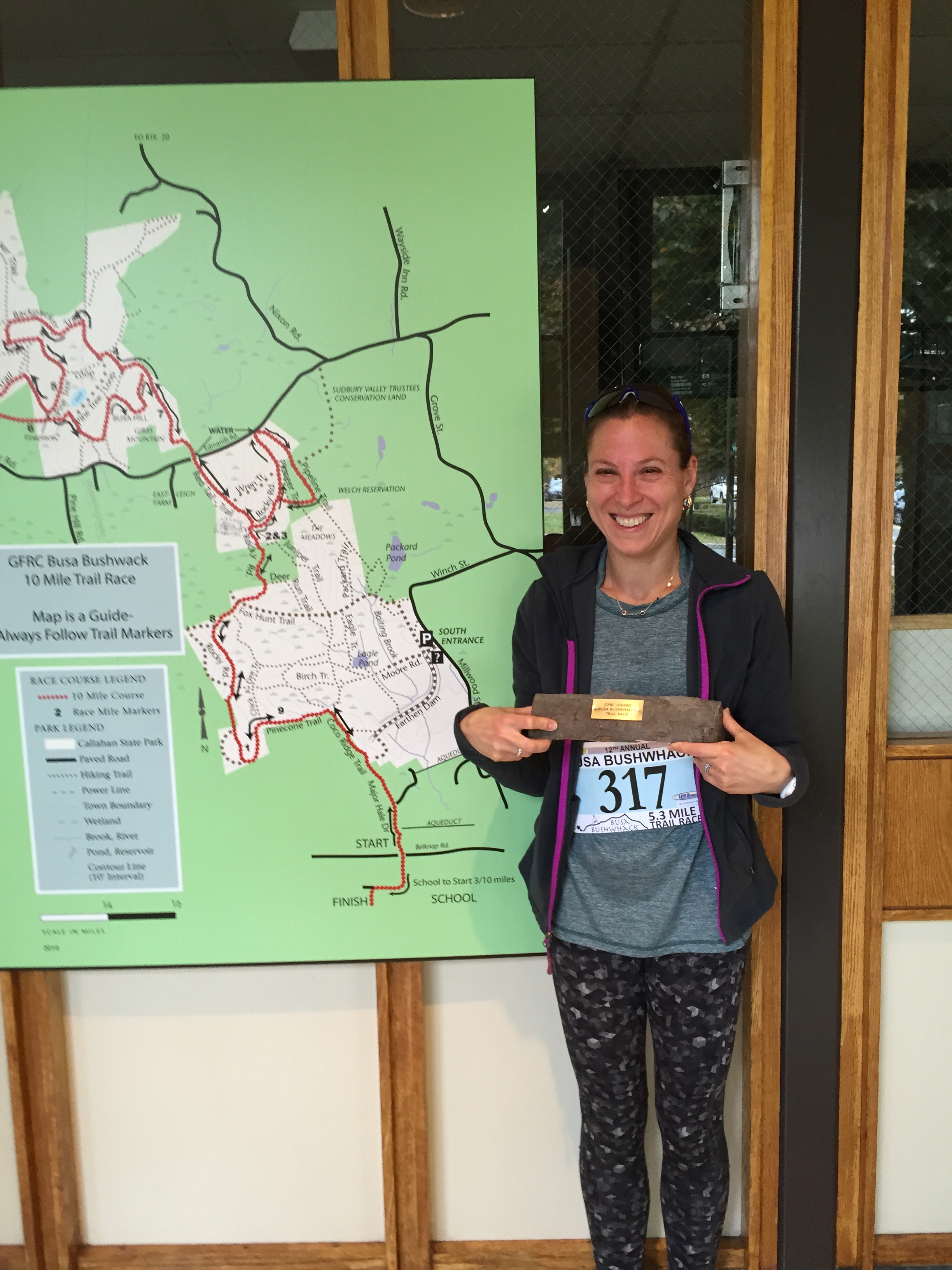
I knew I loved my regular rambling trail runs, so I suspected trail racing would also capture my heart. And it did! 5.3 miles of leaping from rock to rock, weaving through roots and mud, scrambling up a monster hill, and breathlessly trying to stay on the heels of the college cross-country runner in front of me led to a triumphantly exhilarating second-place finish. To this masters runner, there aren’t many better ways to spend a morning! It’s definitely something all you road racers should give a try. . . after reading these tips of course!
Pre-Race
1. You gotta train your brain to perceive the terrain. Okay, I stole that one from Salty. But it’s true. If you want to race on trails, you need to train on trails at least some of the time. If you are able to train on the course you will be racing on, even better. Get acclimated to dealing with the challenges of varied footing and terrain.
2. Invest in some good trail shoes. When I first started running on trails, I just wore my regular daily trainers. What a difference once I got myself a proper pair of trail shoes! I was able to attack the terrain with much more confidence with the added stability and traction, which served me well on race day. The more water-resistant material most trail shoes are made of is also a bonus.
3. Phone a friend. Recruit some of your more experienced trail-loving friends to join you for a training run or two. They can give you advice along the way, and you can also see and learn from how they approach more technical sections.
4. Be prepared. If you are unfamiliar with the course, arrive early on race day and check it out ahead of time. Run part of your warm-up on the course if possible. Make note of the big climbs and technical sections. Familiarize yourself with the course map and markings so you don’t get lost during the race. If your race is long enough to require refueling and rehydration, make sure you know what will be provided and be prepared to carry anything else you will need.
The Race
1. Put yourself in position. If you’re racing to place, position yourself right up front at the start. Most trail races start on a road or wide trail before narrowing to a single track, so you need run aggressively early on to get out in front and avoid bottlenecks. This can be different for those used to road racing, where controlling the start to achieve even or negative splits is customary practice.
2. Focus on effort, not target pace. Because of terrain variation, it will be difficult to dial into a consistent target pace so try to run by feel instead. Navigating uneven terrain may consume much more energy than you are expecting, so pay attention to what the race effort feels like and adjust accordingly.
3. Technique. Be sure to pick up your feet, and even employ a bounding-type movement with higher knees. On steep downhills, running with a wider stance, skipping, or switch-backing can be helpful. Though it’s important to periodically look ahead, keep your focus on the trail itself because of terrain variations.
4. Use technical sections to your advantage. You will need to slow down through more technical sections, but you can use these slow-downs to recover from the harder efforts sustained on smoother parts of the trail. Speed up again when you get past the roots or sections of rough terrain.
5. Passing. Passing others is much less straightforward on single track than it is on the roads. You will need to be judicious about when, how, and how often you pass. It takes more energy than on the roads and you will likely be moving into less optimal footing while you are passing – so be speedy but careful. If necessary, it’s okay to ask people to move over or to announce that you are trying to pass them, i.e. “On your left!”
6. Hills. Consider power-hiking the steep hills. You will likely pass people who are running, and you will conserve your energy so you can be more aggressive on flatter or downhill sections. If your race is long enough to require refueling, an ideal time to do it is while quickly walking up a hill.
7. Be conscious of your environment. Don’t litter! Never drop your gel wrapper or cup from the aid station on the ground or near a course marker. Even for shorter races, if you pack it in, you pack it out.
8. Make note of small victories. Challenge yourself to achieve minor milestones during the race, instead of thinking about the race as a whole. For example, notice how many people you can pass on a hill, or how quickly you can get through a technical patch without losing control. Stay in the moment.
9. Place not pace. Finishing times are not nearly as important in trail racing – it’s all about where you place compared to others dealing with the challenges of the course on that day. So go get that person running just ahead of you!